Kumasi, Ghana · Garden City University · BSc 2024 — Present
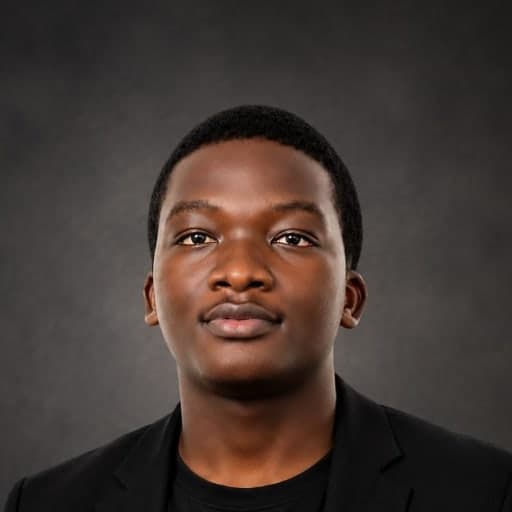
Emmanuel Kakari Ameyaw
Computer Science Undergraduate
Machine Learning · Efficient AI · ML Systems
I study how machine learning models can become smaller, faster, and more efficient without giving up what makes them useful.
Fig. 01 — Quantization field
FP32
32-bit float
FP16
16-bit float
INT8
8-bit integer
INT4
4-bit integer
01 / Orientation
Kumasi · Ghana
An undergraduate with a research direction, working out how far it can be taken.
I am in the fourth year of a BSc in Computer Science at Garden City University. Alongside coursework I run my own experiments on efficient machine learning — mostly quantization and compression of neural networks, measured on hardware I actually have rather than hardware I would like to have.
That constraint has turned into the thing I find most interesting. A model is not only a set of parameters; it is a computation that has to fit inside a machine with a fixed amount of memory, bandwidth, and time.
- Position
- Computer Science undergraduate · fourth year · 2024 — Present
- Institution
- Garden City University
- Direction
- Efficient AI · model quantization · hardware-aware ML systems
- Currently
- Bachelor’s thesis in developmentDeveloping
02 / Direction
The question the rest of this site is about
How can machine learning systems become more computationally efficient while maintaining useful levels of accuracy and reliability?
Efficiency is usually treated as something applied to a model after the research is finished. I am more interested in the opposite reading: that numerical precision, memory, and hardware cost are properties of a model worth studying directly, and that they interact with accuracy and reliability in ways worth measuring rather than assuming.
Efficient AI
- Quantization
- Compression
- Mixed Precision
- Efficient Inference
ML Systems
- GPU Computing
- Hardware-Aware Optimization
- Inference Systems
- Deployment
Deep Learning
- Transformers
- Computer Vision
- NLP
- Generative AI
Reliable AI
- Explainability
- Uncertainty
- Calibration
- Fairness
03 / Work
RTX 4060 Laptop · CUDA · 8GB VRAM
Two projects that carry the direction so far.
QuantLab
ActiveA research framework for hardware-aware mixed-precision quantization of transformer architectures. Layer-wise sensitivity analysis, precision allocation, and GPU benchmarking in one reproducible loop, so an allocation is only accepted once its real cost has been measured.
Post-training quantization·NF4·NSGA-II·Pareto optimization
Fig. 02 — Pareto frontier
Explainable Multimodal Medical AI
CompletedSkin cancer risk stratification
Dermoscopic images and structured clinical metadata fused in one classifier, then examined rather than trusted: attribution over pixels and variables, predictive uncertainty, calibrated confidence, patient-level validation, and error rates reported per demographic group.
04 / Current
Bachelor’s thesis · 2026 — Present
Hardware-Aware Mixed-Precision Quantization for Transformers
The thesis asks a narrow version of the general question: if sensitivity to quantization is unevenly distributed across a transformer, how should a fixed bit budget be allocated across its components — and does allocating with measured hardware cost in the loop beat allocating from sensitivity alone?
Developing
Method
- 01
Transformer
A pretrained model taken as given, with its components treated as separately compressible objects.
- 02
Layer sensitivity
Per-component measurement of how much quality is lost when that component alone is quantized.
- 03
Precision allocation
A bit budget distributed across components according to measured sensitivity rather than uniformly.
- 04
Hardware benchmarking
Execution on a real accelerator, because a format only helps if a kernel exists for it.
- 05
Accuracy · memory · latency
Three numbers reported together, since improving one at the cost of the others is not a result.
- 06
Pareto optimization
Search over allocations, keeping the configurations that nothing else dominates.
Fig. 03 — Layer sensitivity
Nothing here is a finished result yet. The current work is measurement methodology: establishing whether a sensitivity ranking is stable enough to be the input to a search at all.
05 / Trajectory
Stated as intention, not as result
Where this is going.
- In Progress
Hardware-Aware Mixed-Precision Quantization for Transformers
Bachelor's thesis
2026 — Present
- Planned
BitFlex
Adaptive precision transformer inference
Next
- Planned
EdgeFormer
Hardware-aware transformer optimization for constrained devices
Later
- Planned
ParetoML
Accuracy–efficiency optimization tooling
Later
- Planned
AutoQuant
Automated transformer compression
Later
06 / Notes
Working notes · not publications
Questions I keep returning to.
18 July 2026
What makes INT4 quantization difficult
Sixteen reconstruction levels is not many. A look at why the step from INT8 to INT4 behaves less like a smaller version of the same problem and more like a different one.
30 June 2026
Why some transformer layers resist quantization
Sensitivity is not uniform across depth or across components. What I keep observing, and which explanations I find convincing so far.
11 June 2026
Accuracy, latency, memory: reading a three-way trade-off
A single number cannot describe a compressed model. Notes on Pareto fronts, dominated configurations, and why reporting one axis at a time is misleading.
Concept · The model and the machine
A transformer is not only a neural network. It is a computational object running inside a machine with memory limits, bandwidth limits, latency, and a finite number of bits. My research sits where those two descriptions meet.